
Website Development Cost in India: 2026 Pricing Guide by Site Type
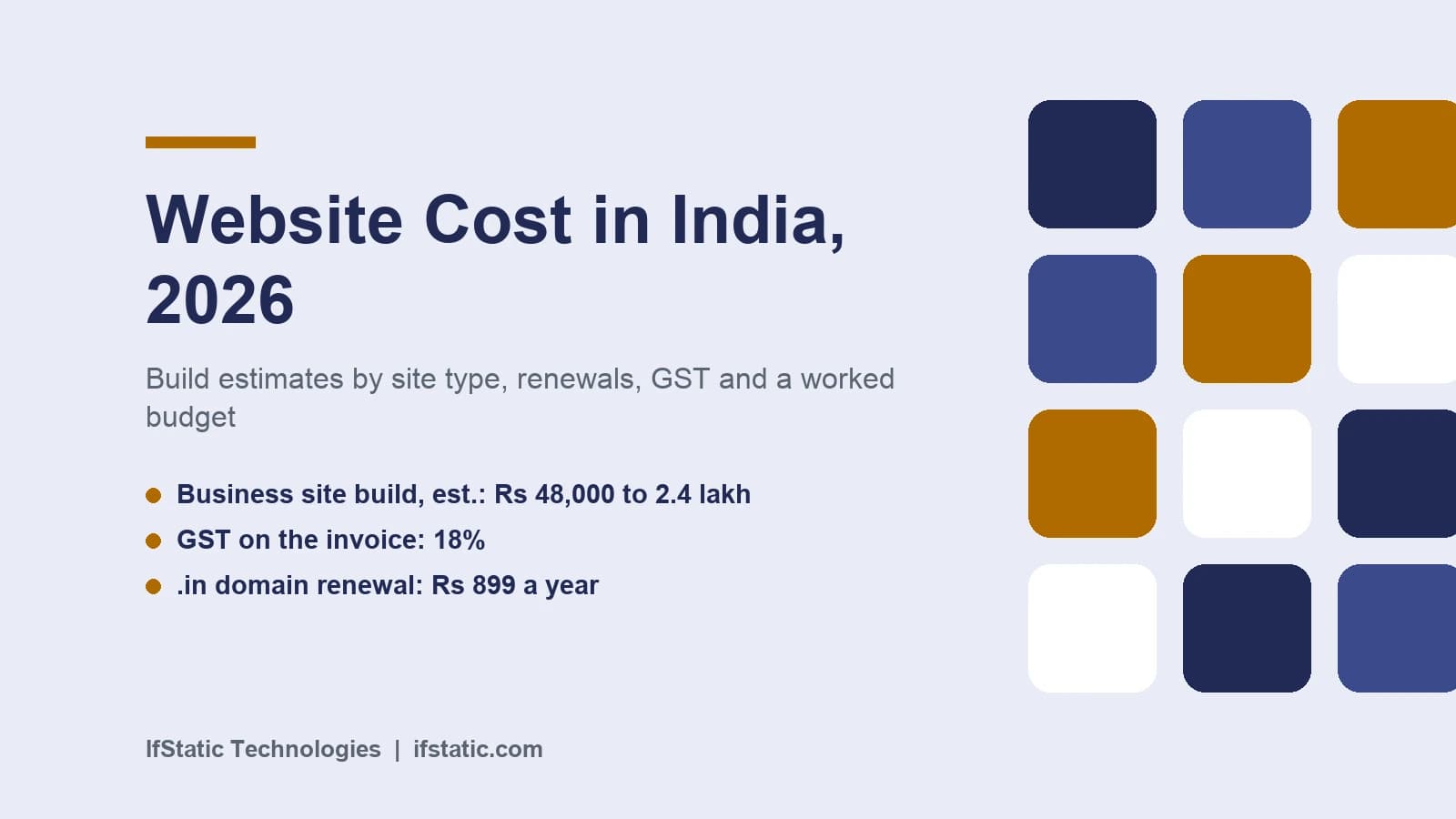
Website development cost in India in 2026 starts at about ₹16,000 for a simple landing page and can pass ₹18 lakh (₹18,00,000) for a custom web application. In our estimates, a typical small business website falls between ₹48,000 and ₹2.4 lakh to build. The build is only the first bill, so if you are planning a new business website, the renewals deserve equal attention.
This guide breaks the price down by type of site, explains what pushes it up, and lists the running costs that most quotes quietly leave out. Every third-party price comes from an official pricing page we opened on 25 September 2026, while every build figure is an estimate with its hours and rates shown. You will also see how GST works on the invoice, a worked two-year budget, and a checklist for comparing quotes.
Key Takeaways
- Our build estimates run from about ₹16,000 for a landing page to ₹18 lakh or more for a web application, at an assumed ₹800 to ₹1,500 an hour.
- Page count, custom design, integrations such as a payment gateway, and content are the biggest drivers of the build price.
- Introductory prices hide the real running cost: a .in domain that costs ₹1 in year one renews at ₹899 a year at Hostinger.
- A GST-registered developer adds 18% GST to the invoice, so ask every vendor to show the tax on a separate line.
- Compare quotes on scope, ownership and year-two costs, not on the headline number alone.
Website Development Cost in India by Website Type
There is no official rate card for web work in India, so any price you read online is an estimate rather than a fixed market rate. The fairest way to compare projects is effort, so we estimated the hours a small team needs for each type of site. We then multiplied those hours by an assumed blended rate of ₹800 to ₹1,500 per hour.
That blended rate mixes designer, developer and tester time, and it is our own assumption for this guide, not a published market rate or an IfStatic price. The low end of each range pairs the fewest hours with ₹800, and the high end pairs the most hours with ₹1,500. Content writing, stock photography, paid plugins and GST all sit outside these figures.
| Website type | Typical scope | Estimated hours | Estimated build cost (before GST) |
|---|---|---|---|
| Landing page | 1 page, lead form, tracking | 20 to 50 | ₹16,000 to ₹75,000 |
| Portfolio website | 4 to 8 pages, gallery, contact form | 30 to 70 | ₹24,000 to ₹1,05,000 |
| Corporate or business website | 8 to 20 pages, custom design, CMS | 60 to 160 | ₹48,000 to ₹2,40,000 |
| Blog or content website | CMS, categories, author pages, SEO setup | 50 to 120 | ₹40,000 to ₹1,80,000 |
| E-commerce website | Catalogue, cart, payment gateway, shipping rules | 120 to 350 | ₹96,000 to ₹5,25,000 |
| Web application | Logins, dashboards, database, admin panel | 400 to 1,200 | ₹3,20,000 to ₹18,00,000 |
Use the table as a sanity check on the quotes you receive rather than as an official price list. A quote far below the low end usually means a template with very little custom work, while a quote far above the high end should come with a clear reason. Below, each type gets a short note on who it suits and when it is the wrong choice.
Landing Pages
A landing page does one job, such as collecting enquiries for a Google Ads or Meta campaign. It therefore needs a strong opening section, a form, a thank-you page and conversion tracking. Most of the hours go into persuasive copy, clean design and fast loading on mobile networks. Wrong fit: a business with several services to explain, because one page cannot rank for many different searches.
Portfolio Websites
Designers, photographers, architects and consultants use portfolio websites to present their work to potential clients. The cost rises with the number of case studies and with how carefully the images are optimised, while a good template on a CMS keeps it near the low end. Wrong fit: anyone who wants to sell products or take bookings, since a portfolio build has no checkout logic.
Corporate and Business Websites
This is the most common category of project, covering the home page, about page, service pages, contact page and often a blog. Custom design, a content management system and a few integrations push it toward the middle of the range. The Clotouch POS website is one product-led business site we have built.
Wrong fit: a firm with a single offer and a limited advertising budget. A landing page serves that need at a lower cost, and you can eventually grow into a complete website.
Blog and Content Websites
News portals, educators and content-led brands need clean category structure, fast templates and sound SEO settings from the first day. The build itself is modest, but publishing content is the ongoing cost that decides whether the site earns traffic. Wrong fit: a business with no plan to publish regularly, because an empty blog wastes the setup and looks neglected to visitors.
E-commerce Websites
An online store adds product pages, a cart, checkout, a payment gateway, shipping rules, GST invoices and order emails, and each integration adds hours of building and testing. A hosted platform such as Shopify cuts build time but adds a monthly subscription. Wrong fit: a seller with a handful of products who takes every order on WhatsApp, where a simple catalogue page may be enough.
Web Applications
Customer portals, booking systems, dashboards and SaaS tools are software projects rather than websites in the usual sense. They need user accounts, roles, a database and an admin panel, and development teams often price them by sprint instead of by page. Our sibling guide on app development cost in India explains that pricing model in depth.
Wrong fit: a first-time founder who has not yet tested demand. A landing page with a waitlist is a cheaper first step, and it tells you whether the bigger investment is justified.
What Drives the Price Up or Down
Website development cost in India varies so much because two quotes for a website often describe two completely different projects. One vendor may be quoting a theme with light edits, while another is quoting a custom design with content, SEO and a payment gateway. The six factors in the table below explain most of the gap between quotes.
| Factor | Keeps the cost lower | Pushes the cost higher |
|---|---|---|
| Number of pages | 5 to 8 pages built from shared templates | 25 or more pages, each with its own layout |
| Design | Licensed theme with light edits | Custom mock-ups with several revision rounds |
| Build method | CMS such as WordPress | Custom code on a web framework |
| Integrations | Contact form and WhatsApp link | Payment gateway, CRM, ERP or shipping API |
| Content | You supply final text and photos | Agency writes copy and arranges photos |
| SEO setup | Titles, meta descriptions and sitemap | Keyword research, schema and redirects from an old site |
Pages and design move the price the most on simple sites, because every unique layout needs design time, build time and testing on phones and desktops. Reusing a few strong templates across many pages is the easiest saving you can make without hurting quality or consistency. Before you accept a quote, ask these questions:
- Can three or four page templates cover every page, instead of a unique layout for each one?
- Can we launch with the core pages first and add the blog or resources section in a second phase?
- Which features can use a well-supported plugin or service rather than custom code?
- Can we supply final text, photos and product data before design starts, so nothing waits on content?
CMS or Custom Code
A CMS such as WordPress gives you a ready-made admin panel, so fewer hours go into basic features like page editing and user roles. Custom code costs more up front, but it suits unusual workflows, heavy traffic or strict security requirements. We compare both routes in detail in WordPress vs custom website.
If WordPress fits your needs, a WordPress design team can often reuse proven plugins instead of writing features from scratch. That saves build hours, although every paid plugin adds a yearly licence to your running costs.
Integrations and Payment Gateways
Each integration needs set-up, testing and error handling, and a payment gateway is the most common example. Razorpay's pricing page lists a 2% platform fee plus GST on each payment, with ₹0 setup and ₹0 annual maintenance charges. That fee is a running cost rather than a build cost, but your developer still needs hours to connect it, test refunds and handle failed payments.
Content and SEO Setup
Content is the item most often missing from a quote, and if the agency writes your pages, the price will rise accordingly. The same principle applies to SEO, where basic on-page setup should be included, so verify that it is written into the scope. Keyword research, schema and redirects from an old site are usually extra, and ongoing SEO services need a separate monthly budget.
Running Costs People Forget
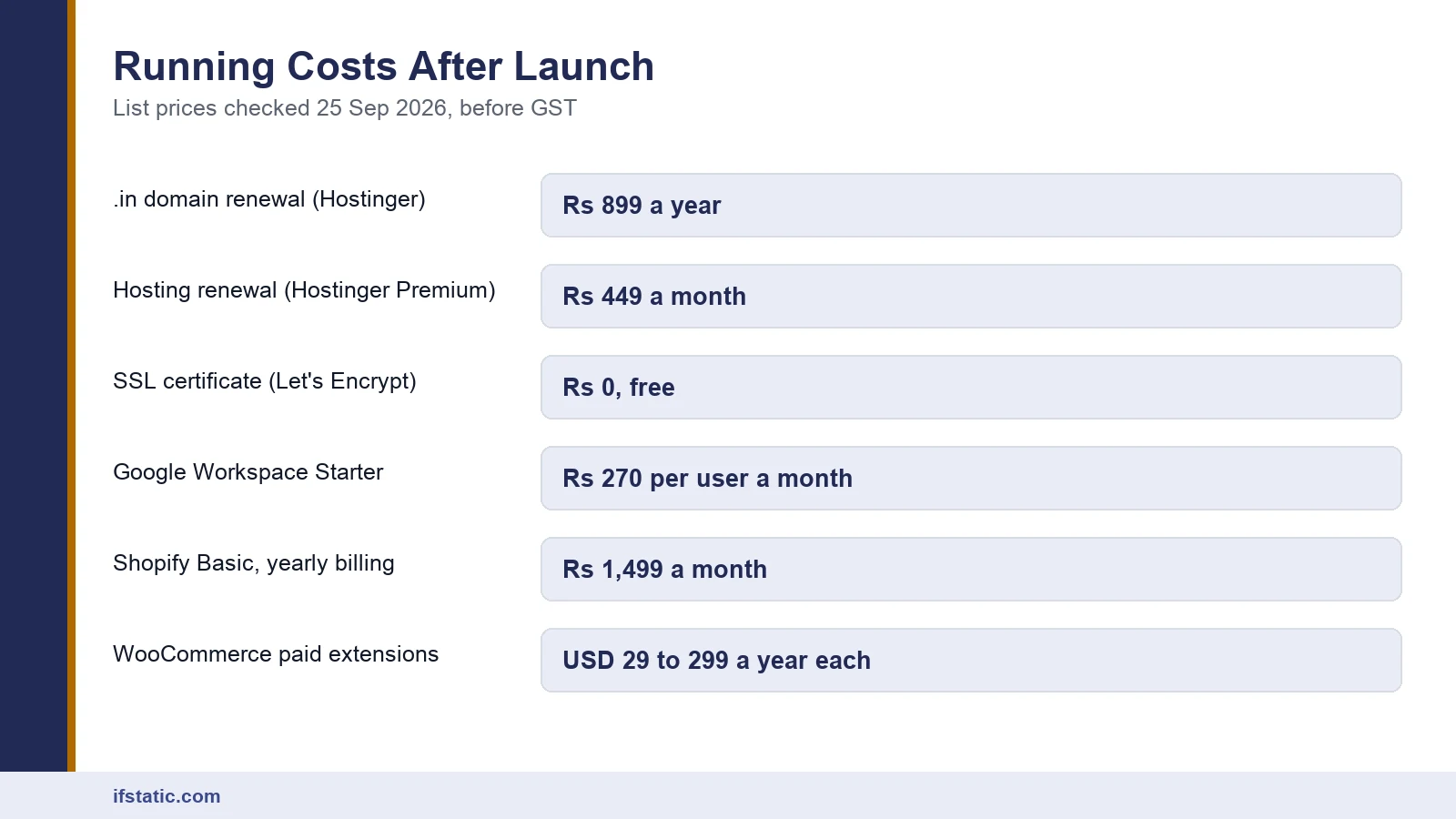
A website keeps costing money after launch, yet most quotes cover only the build, and the renewals arrive a year or more later. Below are list prices from official pricing pages, checked on 25 September 2026, and they exclude GST unless the table says otherwise.
| Item | Official list price | What to watch |
|---|---|---|
| .in domain (Hostinger) | ₹1 for year one, then ₹899 a year | The renewal is the real price |
| Shared hosting (Hostinger Premium) | ₹149 a month on a 48-month term (₹7,152) | Renews at ₹449 a month |
| SSL certificate (Let's Encrypt) | ₹0 | Free, but it must auto-renew |
| Business email (Google Workspace Starter) | ₹270 per user a month | Excludes tax; multiply by users |
| Shopify Basic | ₹1,994 a month, or ₹1,499 a month billed yearly | 2% fee with third-party payment providers |
| WooCommerce | Core plugin free; extensions $29 to $299 a year each | Paid extensions renew every year |
| Payment gateway (Razorpay) | 2% per payment plus GST | ₹0 setup, ₹0 annual charges |
| Maintenance (our estimate) | 2 to 6 hours a month | Updates, backups and fixes |
Domain Renewal
Domains are usually sold with steep first-year discounts, and the renewal price is the figure that really matters over time. Hostinger's .in domain page lists ₹1 for the first year and ₹899 a year after that. Under NIXI, which runs the .in registry, each accredited registrar sets its own price, and the registry requires KYC details at registration.
Register the domain in your own business name, using your own email address rather than the developer's. If a vendor controls your domain and the relationship later ends, recovering it can be slow and frustrating.
Hosting and SSL
Shared hosting is inexpensive when you commit to a long prepaid term. Hostinger's Premium plan displays ₹149 a month when you pay for 48 months up front, which comes to ₹7,152. That price also includes a free domain for the first year, but the plan then renews at ₹449 a month, roughly three times the introductory rate.
SSL encryption no longer needs to be an expensive line item on a website invoice. Let's Encrypt issues trusted certificates at zero cost, and many hosting plans, including Hostinger's, bundle SSL at no extra charge. Pay for a commercial certificate only when you have a specific need, and ask the vendor to name that need in writing.
Business Email
An email address at your own domain builds trust with customers, and it is billed per person. Google Workspace's India pricing page lists the Starter plan at ₹270 per user a month, before tax, so a team of five pays ₹16,200 a year. A mailbox bundled with a hosting plan is usually adequate for one or two users with simple requirements.
Maintenance, Plugins and Theme Licences
Someone has to update the CMS, plugins and theme, check backups and fix whatever breaks after an update. We estimate 2 to 6 hours a month for a typical business website. At the ₹800 to ₹1,500 hourly rate used above, that works out to ₹1,600 to ₹9,000 a month. Skipping maintenance is a false saving, because outdated plugins leave known security holes open.
Premium plugins and themes usually carry annual licences, which renew every year as well. WooCommerce's pricing page says the core plugin is free with no revenue share, while its paid extensions cost $29 to $299 a year each. Ask your developer to document every paid licence, who legally owns it, and what it will cost to renew.
E-commerce Fees: Shopify vs WooCommerce
For online stores, the choice of platform significantly changes the monthly bill. Shopify's India pricing page lists the Basic plan at ₹1,994 a month, or ₹1,499 a month on yearly billing. On Basic, it also lists a 2% fee whenever you use a third-party payment provider. WooCommerce charges no platform fee, but you pay separately for hosting and extensions.
Here is the fee maths on a ₹1,000 order, assuming a third-party gateway such as Razorpay at 2% plus 18% GST on the gateway fee. The comparison leaves out any tax on Shopify's own fee, so treat the Shopify figure as a minimum.
| Cost on a ₹1,000 order | Shopify Basic with Razorpay | WooCommerce with Razorpay |
|---|---|---|
| Platform transaction fee | ₹20 (2%) | ₹0 |
| Gateway fee | ₹20 (2%) | ₹20 (2%) |
| GST on gateway fee (18%) | ₹3.60 | ₹3.60 |
| Total fees per order | ₹43.60 | ₹23.60 |
| Fixed monthly cost | ₹1,499 plan (yearly billing) | Hosting plus any paid extensions |
Shopify costs less to build and needs less technical upkeep, while WooCommerce costs more to build but keeps more of each sale. At higher order volumes, the 2% platform fee can outweigh the extra build cost, so run the numbers with your own expected sales before you choose.
GST on Website Development
GST is the line item that surprises most first-time buyers of a professional website. The GST rate schedule for services on the CBIC site sets 18%, with full input tax credit, for all services not specified elsewhere. Website work is not given a lower rate, so a GST-registered developer or agency adds 18% to the invoice.
This adds a clear, predictable amount to website development cost in India. On a build estimate of ₹90,000, GST comes to ₹16,200, which makes the total ₹1,06,200. The same rate applies to maintenance retainers, and hosting and email sellers also bill tax on top of their list prices.
- Ask every vendor to quote the price before GST and the GST amount on separate lines, so the totals compare fairly.
- If your business is GST-registered and the site is used for business, you can usually claim the GST as input tax credit, but confirm this with your accountant.
- An unregistered freelancer cannot charge GST, but also cannot give you a tax invoice that supports an input credit claim.
- Check that the GSTIN printed on the invoice matches the vendor's registered business name.
- Tools billed in dollars, such as some premium plugins, may add tax at checkout and will move with the exchange rate.
A Worked Example: Two-Year Budget for a Business Website
Here is a sample budget that shows how website development cost in India adds up over two years, for a 10-page business website at a service firm in Noida. The numbers are illustrative, built from the estimates and list prices above, and they are not a quote from IfStatic or anyone else. Change any assumption and the totals will move with it.
- Build: 90 hours at ₹1,000 an hour, which is ₹90,000 for design, development and testing on WordPress.
- Hosting: Hostinger Premium on the 48-month term, paid up front at ₹7,152, with the .in domain free for the first year.
- Domain: the .in domain renews at ₹899 in year two, the registrar's standard renewal price.
- Email: Google Workspace Starter for five users at ₹270 each per month.
- SSL: free, because a certificate is included with the hosting plan.
- Maintenance: 3 hours a month at ₹1,000, starting after a three-month launch warranty.
- GST: 18% on every line, which is the residual rate in the CBIC schedule.
| Line item | Year one | Year two |
|---|---|---|
| Design and development | ₹90,000 | ₹0 |
| Hosting (48 months prepaid) | ₹7,152 | ₹0 |
| .in domain | ₹0 | ₹899 |
| SSL certificate | ₹0 | ₹0 |
| Business email, 5 users | ₹16,200 | ₹16,200 |
| Maintenance | ₹27,000 (9 months) | ₹36,000 |
| Subtotal before GST | ₹1,40,352 | ₹53,099 |
| GST at 18% | ₹25,263 | ₹9,558 |
| Total | ₹1,65,615 | ₹62,657 |
The initial build accounts for approximately 64% of the year-one subtotal in this example. In year two, running costs alone come to ₹62,657, which is roughly 38% of the year-one total, and that is the number most budgets forget to include.
The hosting term ends after four years, and in year five the plan renews at ₹449 a month, or ₹5,388 a year before GST. Put that renewal date in your calendar immediately, so the increase does not surprise your finance team.
You can trim this budget without damaging the quality of the finished website. Two email users instead of five saves ₹9,720 a year before tax, and a lighter maintenance plan saves more. What you should not cut is the quality of the pages that bring in enquiries.
How to Compare Website Development Quotes
Put every quote into the same format before you compare prices, because a lower number often means a smaller scope rather than a better deal. Use the checklist below to line the quotes up side by side.
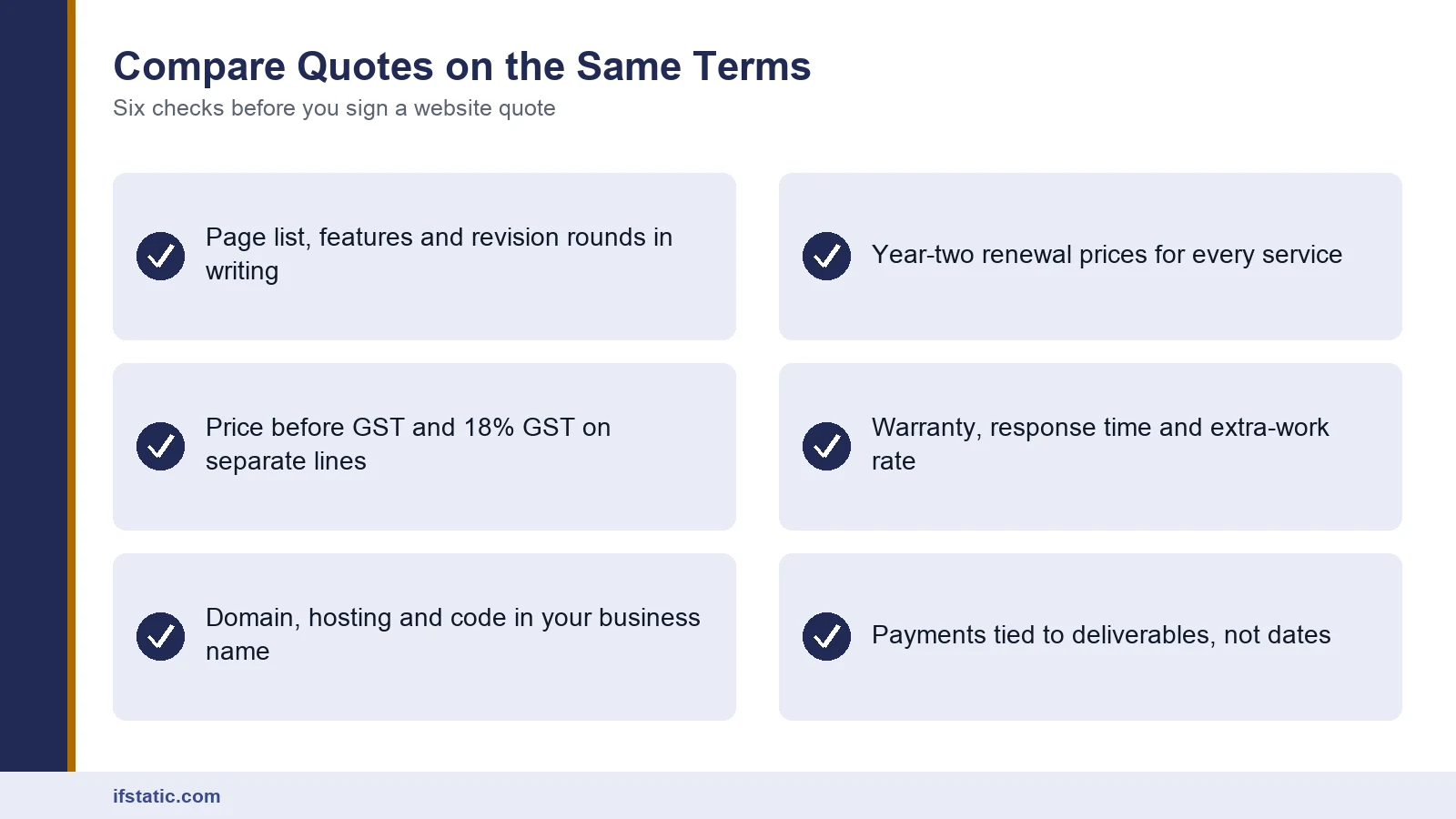
- Scope in writing: the page list, features, integrations and number of design revisions.
- The price before GST and the GST amount, shown on separate lines of the quotation.
- Who supplies content, images and product data, and what happens if they arrive late.
- Ownership: domain, hosting and code registered to your business, with admin logins handed over at launch.
- Year-two costs: renewal prices for the domain, hosting, email, plugins and maintenance.
- Support after launch: warranty period, response time and the hourly rate for extra work.
- SEO and speed basics: titles, meta descriptions, sitemap, redirects and a page speed check before launch.
- Payment milestones tied to approved deliverables rather than to calendar dates.
Red Flags in a Low Quote
- A single lump sum with no itemised page list or feature list attached.
- The domain or hosting account registered in the vendor's name instead of your business name.
- Pirated themes or plugins, which receive no security updates and can carry malicious code.
- No mention of backups, software updates or who is responsible for fixing bugs after launch.
- A promise of top Google rankings by a fixed date, which no honest provider can control.
A higher quote is not always better either, so ask exactly what the extra money buys. If the answer is pages or features you do not need, that quote is the wrong fit for your budget. You can see the kind of sites we build in our website development portfolio.
Conclusion
The honest answer to website development cost in India is a range, and it narrows quickly once you fix the type of site, the page list and the integrations. Use the estimates here to test the quotes you receive, then add the running costs and 18% GST before you settle on a budget.
If you want a written, line-by-line quote that includes year-two costs, contact IfStatic with your page list and features. We will show you where the money goes and where a cheaper option makes sense.
Frequently Asked Questions
What Is the Average Website Development Cost in India for a Small Business?
There is no official average. Based on the effort estimates in this guide, a small business website with 8 to 20 pages costs about ₹48,000 to ₹2.4 lakh to build, before GST. Design, page count and integrations explain most of the spread. Then add the running costs, which in our worked example came to ₹62,657 in year two, including GST.
How much does an e-commerce website cost in India?
Our estimate for a custom e-commerce build is ₹96,000 to ₹5.25 lakh, based on 120 to 350 hours at ₹800 to ₹1,500 an hour. A Shopify store can cost less to build but adds a monthly plan, which Shopify lists at ₹1,499 a month for Basic on yearly billing. Basic also carries a 2% fee with third-party payment providers.
Is GST charged on website development in India?
Yes, if the developer is GST-registered. The CBIC rate schedule for services sets 18% for services not listed elsewhere, and website work has no lower rate, so a ₹90,000 build becomes ₹1,06,200. A GST-registered business can usually claim this as input tax credit. An unregistered freelancer cannot charge GST and cannot issue a tax invoice either.
What are the yearly running costs of a website in India?
The main yearly costs are domain renewal, hosting, business email and maintenance. At list prices checked on 25 September 2026, a .in domain renews at ₹899 a year at Hostinger, and its Premium hosting renews at ₹449 a month. Google Workspace Starter costs ₹270 per user a month, SSL can be free through Let's Encrypt, and maintenance is the largest variable.
Why do website quotes in India vary so much?
Quotes differ because they usually describe genuinely different projects. One vendor may quote a theme with light edits, while another quotes a custom design with content writing, SEO setup and a payment gateway. Some leave out GST or year-two renewals entirely. Put every quote into the same format, with scope, GST, ownership and running costs listed, before you compare totals.
Should I choose a template website or a custom design?
Choose a template if you need to launch quickly on a limited budget and your content fits a standard layout. Choose custom design if your brand, sales flow or features need something templates cannot handle well. Many businesses start with a well-built template on a CMS and move to custom design once the site proves its value.
Sources, Method and Author
How this guide was researched: we read the Google India top 10 for this keyword on 25 September 2026 and five competing guides in full. Third-party prices come from official pages opened that day: Hostinger, Let's Encrypt, Google Workspace, Shopify, WooCommerce, Razorpay and CBIC. Build costs are our own estimates from stated hours and rates. We found no published, verifiable average build price for India, so none is quoted here.
About the author: Aman Raj is a Director and Website Designer at IfStatic Technologies in Greater Noida West. He works on the design, build and launch of websites and apps for IfStatic clients and writes the company's guides on planning digital projects.