
App Development Cost in India: A 2026 Budget Guide for Founders
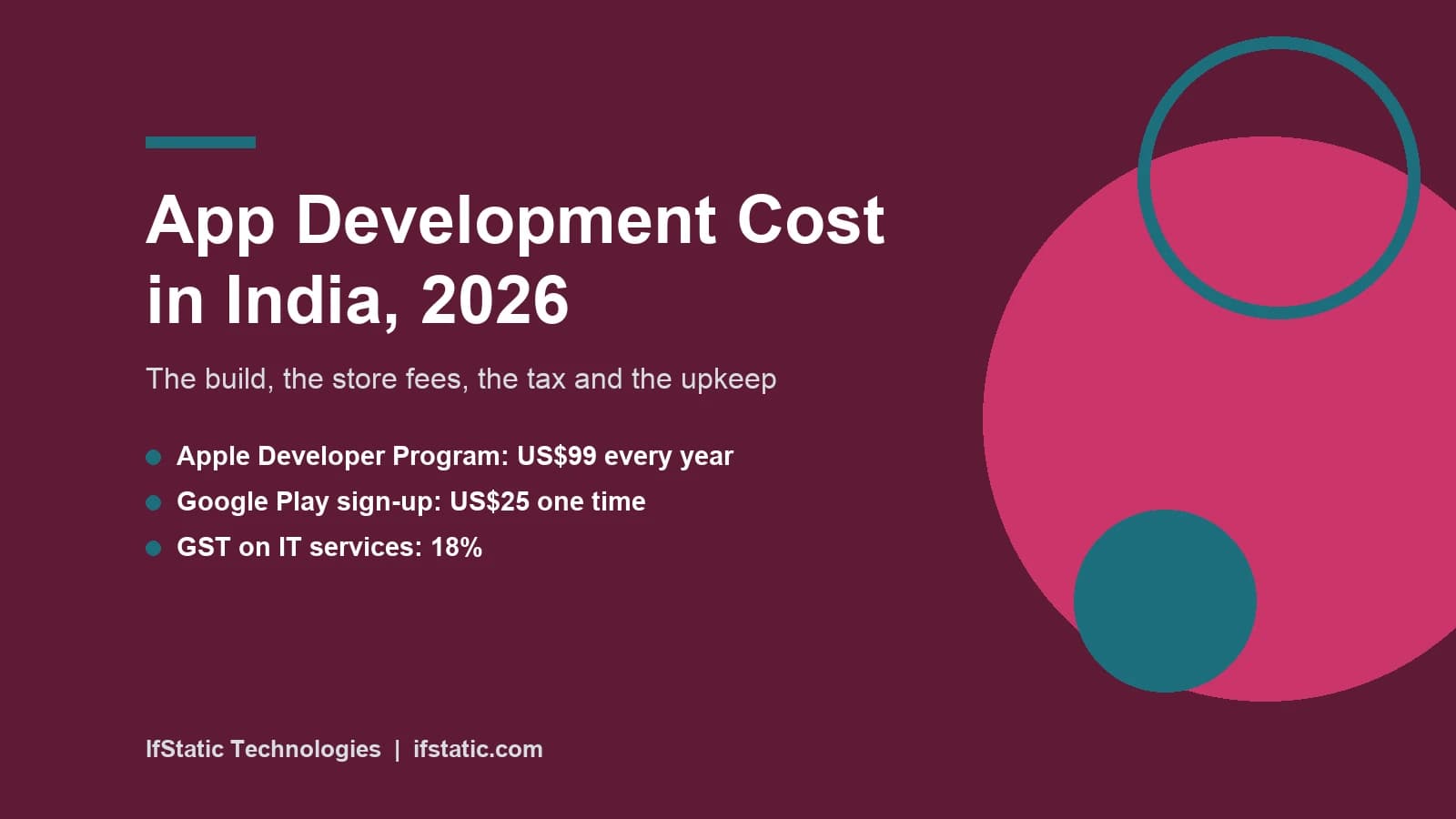
The app development cost in India for 2026 comes down to one calculation: the number of hours a team needs, multiplied by the hourly rate it charges. A simple informational app may need a few hundred hours, while a delivery platform with several connected apps can need a few thousand. This guide from the IfStatic app development team shows you how to estimate both numbers.
It also covers the recurring costs that most price lists leave out. Apple charges an annual fee, Google charges once, the payment gateway deducts a percentage from every sale, and GST adds 18% to a registered vendor's invoice. We verified each fee on its official page on 25 September 2026, then built a sample budget where every number has a stated basis.
Key Takeaways
- Estimate any app as development hours multiplied by an hourly rate; the ₹1,500 rate used here is an illustrative assumption, not a quoted price.
- Store fees are modest but unavoidable: Apple charges US$99 every year for its developer program, while Google Play charges a one-time US$25 registration fee.
- Payments and taxation add meaningful money, because Razorpay's standard rate is 2% plus GST per payment and GST on IT services is 18%.
- Flutter or React Native lets one shared codebase serve Android and iOS, so cross-platform development usually costs noticeably less than two separate native apps.
- In our worked example, a ₹10.5 lakh build becomes roughly ₹14 lakh of first-year spending once taxes, platform fees, hosting and maintenance are included.
What Drives App Development Cost in India in 2026
Every quote you receive rests on the same calculation, even when the vendor does not show it. The team estimates hours for design, app screens, the backend, the admin panel and testing, then multiplies them by a blended hourly rate. Ask every vendor for both numbers, and you can compare any two quotes on genuinely equal terms.
The hours depend mainly on scope and complexity. Every additional screen, user role, payment flow or third-party integration adds development work, and it accumulates quickly. A second user app, such as a rider app alongside a customer app, can almost double the front-end effort. Real-time features like live tracking and chat increase both the build hours and the monthly running costs.
The rate depends on who builds the product. A solo freelancer, a small studio and a large consultancy will price the same hour very differently, depending on experience, process and overheads. Throughout this guide we use ₹1,500 an hour as an illustrative planning rate, purely to demonstrate the arithmetic. It is not a price from IfStatic or any other company, so replace it with the rates in your own quotes.
Cost by Complexity Tier
Most apps fall into one of three complexity tiers. The hour ranges below are our own planning estimates for a cross-platform build, and they include design, the backend, an administration panel and testing, not only the app screens.
| Tier | What it usually includes | Estimated hours | Estimate at ₹1,500 an hour |
|---|---|---|---|
| Simple | 5 to 10 screens, login, content, push alerts, a basic admin panel | 200 to 400 | ₹3 lakh to ₹6 lakh |
| Mid-level | 15 to 30 screens, payments, bookings or orders, an admin panel with reports | 600 to 1,000 | ₹9 lakh to ₹15 lakh |
| Complex | Two or more user apps, live tracking, chat, many roles, outside integrations | 1,400 to 2,500 | ₹21 lakh to ₹37.5 lakh |
Treat these figures as a way to sanity-check a quote rather than as a price list. Your actual hours depend on the number of screens, how customised the design is, and how many external services the application connects to. Here is who each tier does not suit.
- Simple tier. Wrong fit: any application that must accept payments, manage bookings or handle orders from the first day of launch.
- Mid-level tier. Wrong fit: a marketplace that needs a separate, dedicated application for its sellers, vendors or delivery riders.
- Complex tier. Wrong fit: an idea you have not yet validated with real customers, because a smaller first release is usually safer.
If your idea sits in the complex tier, consider launching a smaller first version before committing the full budget. Our guide to MVP app development explains how to reduce scope without removing the core value your customers actually came for.
Cost by App Type: Delivery, E-commerce, Dating, Booking and Internal Apps
App type matters because it determines how many separate applications you need and which paid services run behind them. These are app types IfStatic designs and builds, and the estimates use the same illustrative ₹1,500 hourly rate for direct comparison.
| App type | Parts you usually need | Main cost drivers | Estimated hours | Estimate at ₹1,500 an hour |
|---|---|---|---|---|
| Delivery | Customer app, vendor or rider app, admin panel | Live tracking, order routing, maps, payments | 1,200 to 2,000 | ₹18 lakh to ₹30 lakh |
| E-commerce | Shopper app, admin panel for catalogue and orders | Catalogue, cart, checkout, returns, offers | 700 to 1,300 | ₹10.5 lakh to ₹19.5 lakh |
| Dating | User app, moderation panel | Matching, chat, profile checks, subscriptions | 1,000 to 1,800 | ₹15 lakh to ₹27 lakh |
| Booking | Customer app, venue or staff panel | Slots, calendar rules, payments, reminders | 500 to 900 | ₹7.5 lakh to ₹13.5 lakh |
| Management or internal | Staff app, manager dashboard | Roles, attendance, stock, reports | 400 to 900 | ₹6 lakh to ₹13.5 lakh |
Delivery Apps
A delivery business needs more than one product, because the customer places orders, the vendor or rider fulfils them, and your team manages everything from a panel. WaterGo, a water bottle delivery app we designed, follows this pattern with nearby vendors, route-based orders and real-time status updates. Live location is the largest cost driver, in development hours and in monthly map and server bills.
E-commerce Apps
An e-commerce application is mostly catalogue, cart and checkout, but costs rise with product variants, coupons, returns and inventory synchronisation with a physical store or warehouse. If you already sell through a website, reusing its existing backend can save a considerable number of hours. Payment gateway fees then become your main recurring expense, which we explain further down.
Dating Apps
Dating apps look simple on the surface but carry substantial safety and moderation work, including profile verification, blocking, reporting and a moderation dashboard. The Nearby Match dating and chat app we designed shows nearby profiles, online status, photo and voice messages, and a premium tier. Premium features are often sold as subscriptions, which introduces app store service fees.
Booking Apps
Booking applications usually sit in the middle tier, and the difficult part is the business logic: slot lengths, buffers, cancellations and refunds. BookMyPlay, a sports field booking platform we built, lets owners manage slots and earnings while players discover nearby fields and reserve them. Our worked example later uses a booking app because the numbers are easy to follow.
Management and Internal Apps
Internal applications for staff, inventory or field teams avoid app store marketing and public payments entirely. They still require careful role design, offline capability in some situations, and reports that managers genuinely trust. Because the users are your own employees, you can often launch on Android first and introduce iOS only when people request it.
Wrong fit for a first release: a delivery platform launched across many cities simultaneously. Begin with one delivery zone, prove the order volumes, and then scale the application and the budget together.
Native vs Flutter or React Native: The Budget Effect
Native development means two separate applications, written in Kotlin for Android and Swift for iOS. Cross-platform development means one codebase, written in Flutter or React Native, that runs on both operating systems. The backend, admin panel and design work stay roughly the same either way, while a native project builds the app screens twice.
Here is the arithmetic, presented as an estimate rather than a rule. Imagine a 900-hour cross-platform project in which 500 hours go into the app screens. Building those screens natively for both stores would need close to 1,000 hours, so the project grows to about 1,400 hours, roughly 55% more before additional testing.
| Factor | Flutter or React Native | Native (Kotlin and Swift) |
|---|---|---|
| Codebases | One, shared by Android and iOS | Two, one per platform |
| App screen hours in our example | About 500 | About 1,000 |
| Total hours in our example | About 900 | About 1,400 |
| Estimate at ₹1,500 an hour | About ₹13.5 lakh | About ₹21 lakh |
| Best for | Most business, booking, delivery and e-commerce apps | Heavy device features, rich graphics, deep system hooks |
| Upkeep | One codebase to update | Two codebases to update |
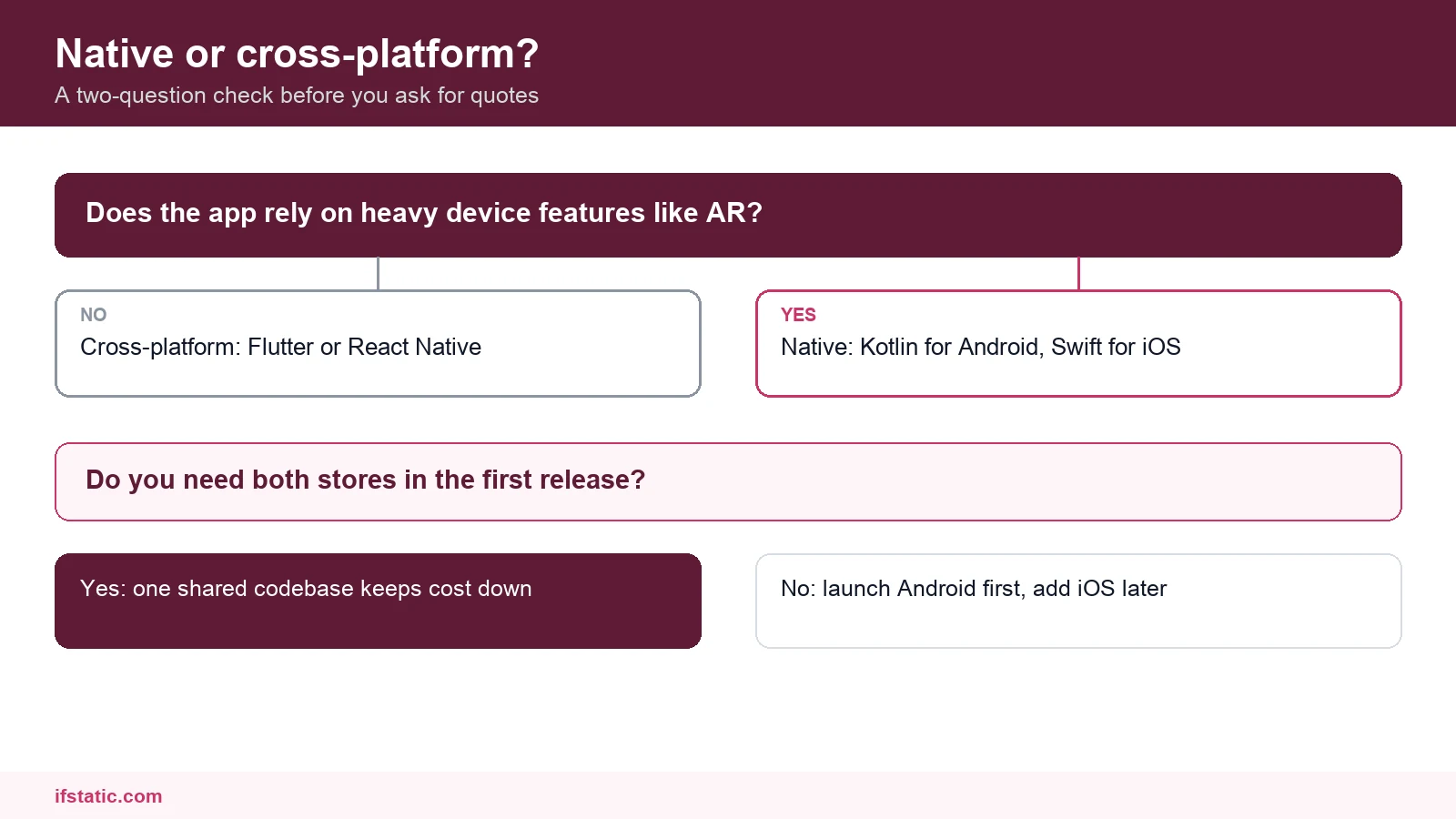
Flutter and React Native cost about the same to build, so choose between them based on team experience and the plugins your features require. React Native suits companies that already write JavaScript for their website, while Flutter offers precise control over the appearance of every screen. IfStatic works with both, and with Kotlin and Swift when a project genuinely requires native code.
- Cross-platform. Wrong fit: applications built around augmented reality, Bluetooth hardware or demanding real-time graphics.
- Native for both stores. Wrong fit: a first release on a limited budget that mostly contains standard screens and forms.
- Android only. Wrong fit: a consumer brand whose paying customers mostly use iPhones.
One more budget lever is timing. You can build cross-platform but publish on one store first, then release on the second after the first version proves itself. That keeps the code ready for both platforms while you concentrate launch effort where your customers already are.
Recurring Costs Most Guides Skip
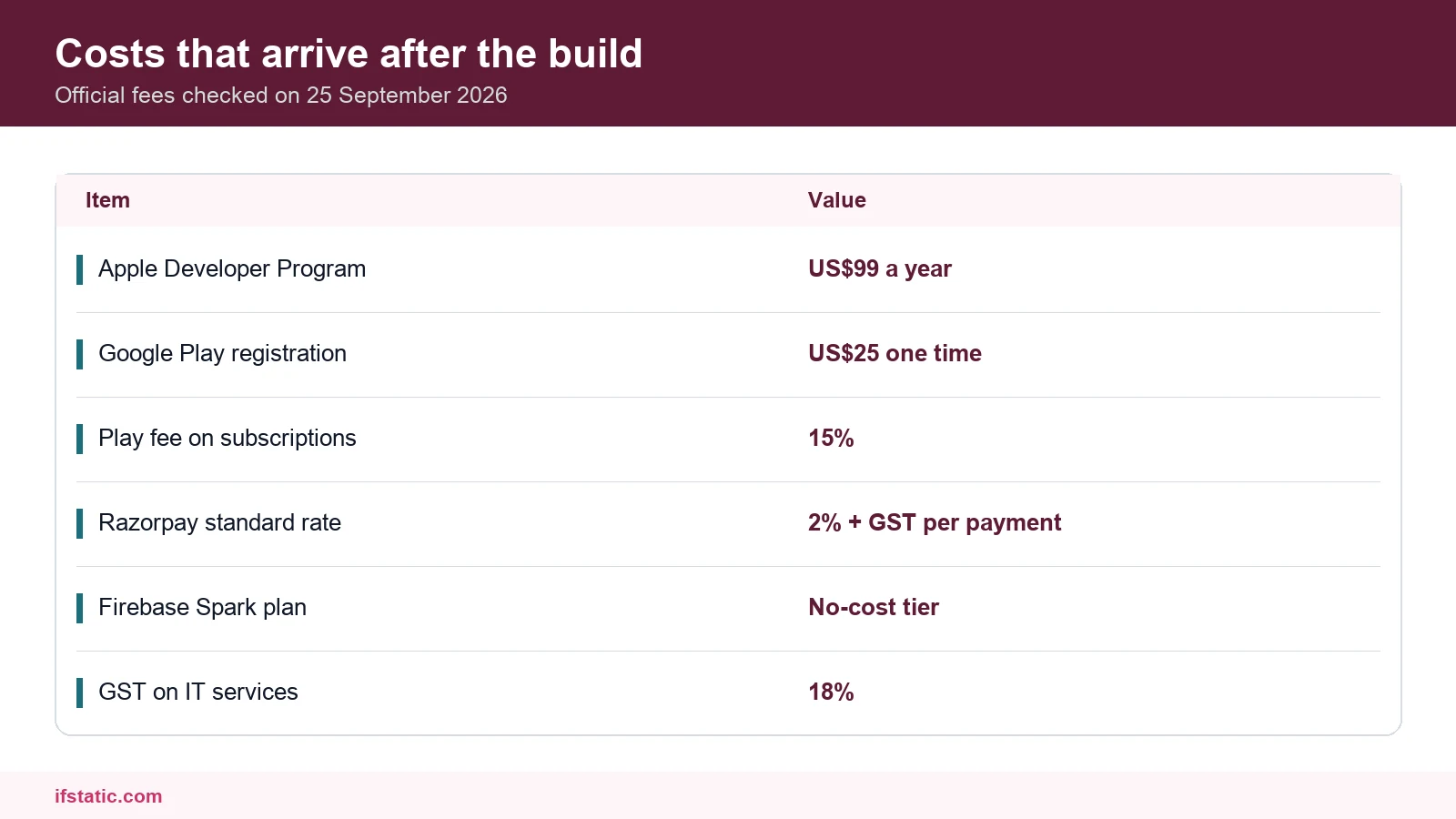
The build is a one-time expense, but these recurring items are also part of the app development cost in India, even though most quotes leave them out. Several top-ranking guides we reviewed either skip them or quote different numbers for the same fee, and one even describes Apple's annual fee as a one-time charge.
Apple and Google Store Fees
Apple charges US$99 a year for the Apple Developer Program, displayed in local currency where available. Its enrollment help page says enrollment in India is only available through the Apple Developer app. An organisation needs a D-U-N-S Number, and Apple does not accept trade names, so a sole proprietor enrolls under their personal legal name.
Google Play charges a one-time US$25 registration fee, and prepaid cards are not accepted for payment. Personal accounts created after 13 November 2023 must also satisfy testing requirements before an app can be published. If you register as an individual rather than an organisation, allow time for this step in your launch schedule.
To convert dollars into rupees, we used the Federal Reserve H.10 exchange rate series, which showed ₹95.87 per US dollar on 18 September 2026. At that rate, the Apple fee is approximately ₹9,500 a year and the Google fee approximately ₹2,400 once. Your bank may add a small foreign transaction charge on top.
Google Play Service Fee on Digital Sales
If your app sells digital goods, such as a dating subscription, Google Play takes a percentage of each sale. Its service fee page lists 15% on auto-renewing subscriptions in markets including India. Developers who offer an alternative billing system to users in India pay 4% less on those particular transactions.
Google also states that 97% of developers pay no service fee at all. A delivery or booking app that sells physical goods or real-world services usually collects money through a payment gateway instead, which brings us to the next recurring cost.
Payment Gateway Fees
Razorpay's standard pricing is 2% per transaction plus GST, which the page lists at 18%. The 2% platform fee also applies to standard UPI payments, even though UPI itself carries a zero merchant discount rate. International cards cost up to 3%, while setup and annual maintenance fees are both ₹0.
On ₹1 lakh of monthly online sales, that means ₹2,000 in fees plus ₹360 GST, or ₹2,360 every month. Razorpay deducts the charge from each payment before settling the remainder to your bank account. It also offers custom pricing for businesses collecting more than ₹5 lakh a month, so negotiate once your volume grows.
Hosting and Backend Services
Many Indian startups begin on Firebase, whose pricing page shows a no-cost Spark plan that requires no payment method. On Spark, Cloud Firestore allows 1 GiB of stored data, 50,000 document reads a day and 20,000 writes a day. Push notifications through Cloud Messaging are also no-cost.
Phone number login is billed per SMS and requires the pay-as-you-go Blaze plan, which you also need once usage passes the free limits. Costs then follow consumption, so a busy delivery app with live tracking pays far more than a quiet internal tool. Ask your developer for a monthly estimate of reads, writes and SMS volume before launch.
GST on App Development Invoices
The GST Council website hosts a CBIC (then CBEC) FAQ on IT and ITeS services. It classifies software development, design and customisation as services, and it states that the GST rate on IT services is 18%. Consequently, a ₹10 lakh quotation from a registered vendor becomes an invoice of ₹11.8 lakh.
The same FAQ says a supplier must register once aggregate turnover exceeds ₹20 lakh in a financial year, or ₹10 lakh in special category states. A small freelancer below that threshold may not charge GST at all. If your own business is GST-registered, ask your accountant whether you can claim the tax as input tax credit.
Maintenance and Updates
Applications need continuous maintenance, because Android and iOS change every year, software libraries become outdated, and users report bugs. We prefer to plan maintenance in hours rather than as a vague percentage of the build. A modest app might need 8 to 12 hours a month, which is ₹12,000 to ₹18,000 a month at ₹1,500 an hour, before GST.
| Recurring item | Official fee or basis | When you pay | Where we checked it |
|---|---|---|---|
| Apple Developer Program | US$99 a year, local currency where available | Every year | Apple enrollment help page |
| Google Play Console | US$25 | Once | Play Console Help |
| Google Play service fee | 15% on auto-renewing subscriptions | On each digital sale | Play Console Help |
| Razorpay standard plan | 2% per payment plus 18% GST on the fee | On each payment | Razorpay pricing page |
| Firebase | Spark no-cost tier, then Blaze pay as you go | Monthly, by usage | Firebase pricing page |
| GST on development | 18% on IT services | On each invoice | CBIC FAQ on IT and ITeS |
| Maintenance | Our estimate: 8 to 12 hours a month | Monthly | Planning assumption |
A Worked Budget Example With Every Assumption Stated
Here is a complete first-year budget for a sample project: a booking application for a sports club with two venues in Greater Noida. It is a fictional scenario created to demonstrate the method, so it is neither a real client nor an IfStatic quotation.
- A Flutter application for Android and iOS, together with a web-based administration panel for venue staff.
- A total of 700 build hours, charged at the illustrative planning rate of ₹1,500 an hour.
- The vendor is GST-registered, so 18% GST applies to both the build and the ongoing maintenance.
- The application launches halfway through the year, which leaves six months of running costs in year one.
- Players pay ₹15 lakh of bookings online through Razorpay during those six months of operation.
- Firebase moves to the Blaze plan after launch, at an assumed average of ₹2,000 a month.
- Maintenance runs at 10 hours a month after launch, billed at the same illustrative rate.
Year-One App Development Cost in India for a Booking App
| Line item | Basis | Amount |
|---|---|---|
| Build | 700 hours at ₹1,500 an hour | ₹10,50,000 |
| GST on build | 18% of ₹10,50,000 | ₹1,89,000 |
| Apple Developer Program | US$99 at ₹95.87 per dollar | About ₹9,500 |
| Google Play registration | US$25 at ₹95.87 per dollar, paid once | About ₹2,400 |
| Firebase Blaze | 6 months at an assumed ₹2,000 a month | ₹12,000 |
| Razorpay fees | 2% of ₹15 lakh, plus 18% GST on the fee | ₹35,400 |
| Maintenance | 6 months of 10 hours at ₹1,500, plus 18% GST | ₹1,06,200 |
| First-year total | Sum of the lines above | About ₹14,04,500 |
The headline build figure was ₹10.5 lakh, yet the realistic first-year spend is about ₹14 lakh, roughly a third higher. Taxation is the largest addition, followed by maintenance. Store fees barely affect the total, but payment fees increase with every booking the club accepts.
If the club is GST-registered and eligible for input tax credit, its net cost falls, but confirm this with an accountant rather than assuming it. Remember too that Razorpay deducts its fee from each payment, so it appears as lower settled revenue rather than as a separate invoice.
Year two looks different: there is no build cost and no Google registration fee, but you pay twelve full months of maintenance, hosting and payment fees, plus Apple's annual renewal.
How to Read an App Development Quote
Two quotations for the same idea can differ widely, and most of that difference comes from scope rather than greed. One vendor may include the admin panel, testing and store submission, while another quietly leaves them for later. Use the table below to compare quotes side by side before you decide.
| Quote line | What to ask | Red flag |
|---|---|---|
| Hours by module | How many hours for design, app, backend, admin and testing? | One lump sum with no breakdown |
| Hourly rate | What blended rate did you use? | Rate hidden or different on every page |
| Platform | Flutter, React Native or native, and why? | No clear answer on the stack |
| Code and accounts | Will the code, store accounts and servers be in my company's name? | Vendor keeps the store accounts |
| Testing and launch | Are store submission and fixes after review included? | Launch listed as a later extra |
| Bug-fix period | How many weeks of free fixes after launch? | No fix period at all |
| GST and outside fees | Is GST included? Which fees do I pay myself? | Tax and store fees not mentioned |
The following routine helps you compare quotations on equal terms. It takes one evening and can prevent expensive surprises later in the project.
- Write a one-page scope covering your users, main screens, payment needs and administration requirements.
- Send the identical scope to every vendor and request an hour estimate for each module.
- Convert every quotation into hours multiplied by rate, and then add 18% GST to each.
- Add the recurring costs from this guide to create a realistic first-year comparison.
- Choose on value and fit, then agree payment milestones linked to working, testable releases.
Be cautious with a quotation far below the others. It frequently leaves out the admin panel, the backend or proper testing, and it may rely on a template that is difficult to change later. Reading every quote this way is the simplest method of controlling your app development cost in India.
If your scope is still unclear, a short design phase usually helps. Clickable screens from a UI/UX design sprint make hours easier to estimate and reduce change requests during development. For an overview of the build stages that follow, see our guide to the Android app development process.
- Red flag: the quotation includes no admin panel, although your team must manage orders or bookings daily.
- Red flag: the vendor wants the Apple and Google developer accounts registered in its own name.
- Red flag: there is no written scope, so every small change becomes a new invoice.
- Good sign: the vendor asks about your customers and revenue model before naming any price.
Conclusion
There is no single app development cost in India, but there is a dependable way to estimate it. Break the work into hours, apply a clearly stated rate and add 18% GST. Then include the recurring fees: Apple every year, Google once, the payment gateway on each sale, hosting as usage grows, and steady maintenance.
If you would like a quotation prepared this way, with hours by module and every external fee listed, talk to the IfStatic team. We build Android, iOS and cross-platform applications from Greater Noida West for businesses across India.
Frequently Asked Questions
What is the average app development cost in India for a small business?
There is no reliable average, because scope varies enormously between projects. At our illustrative rate of ₹1,500 an hour, a simple app of 200 to 400 hours comes to ₹3 lakh to ₹6 lakh. A mid-level app with payments and an admin panel comes to ₹9 lakh to ₹15 lakh, plus 18% GST if your vendor is registered.
Is Flutter cheaper than native app development?
Usually yes, when you need both Android and iOS, because Flutter and React Native share one codebase and the app screens are built only once. In our example, a 900-hour cross-platform project grows to about 1,400 hours as two native apps. Native development still makes sense for applications built around demanding device features.
How much are the Apple and Google developer fees?
Apple charges US$99 a year for the Apple Developer Program, in local currency where available, and Indian developers enroll through the Apple Developer app. Google Play charges a one-time US$25 registration fee. At ₹95.87 per dollar, the Federal Reserve rate for 18 September 2026, that equals roughly ₹9,500 annually and ₹2,400 once.
Do I have to pay GST on app development?
If your developer is GST-registered, yes. The CBIC FAQ on IT services, published on the GST Council website, sets the rate at 18%. Suppliers must register once aggregate turnover exceeds ₹20 lakh a year, or ₹10 lakh in special category states. If your business is registered, ask your accountant about claiming input tax credit.
How much does it cost to maintain an app each year?
Plan maintenance in hours rather than percentages. A modest application might need 8 to 12 hours a month for updates, fixes and small improvements. At ₹1,500 an hour, that is ₹12,000 to ₹18,000 a month before GST. Then add Apple's annual fee, hosting that grows with usage, and payment gateway fees on every sale.
How long does it take to build an app in India?
It depends on the total hours and the size of the team. In our planning, a mid-level app of 600 to 1,000 hours often takes three to five months once design approval, testing and store review are included. Simple apps can be faster, while platforms with several connected apps usually take considerably longer.
Sources, Method and Author
How this guide was researched: on 25 September 2026 we reviewed the Google India top 10 for this search and read eight pages in full. We opened Apple's enrollment page, two Google Play help pages, Razorpay and Firebase pricing, the CBIC GST FAQ and the Federal Reserve H.10 series. Hour ranges and the ₹1,500 rate are our estimates. Apple shows its rupee price only during enrollment, so we could not confirm it.
About the author: Aman Raj is a Director and Website Designer at IfStatic Technologies in Greater Noida West. He works on the design, build and launch of websites and apps for IfStatic clients and writes the company's guides on planning digital projects.