
MVP App Development: How to Scope, Build and Launch Your First App
MVP app development means building the smallest version of your app that can test one risky business assumption with real customers, and then learning from their actual behaviour. It is not an inexpensive, half-finished copy of the complete product. If you are planning to hire a team for mobile app development, this guide explains how to scope, build, launch and measure your first release.
The concept comes from the lean startup movement, and first-time founders usually misunderstand it in the same predictable way. They include every feature they can imagine, spend months in development, and then launch to silence. This guide covers the original definition, four MVP types, a step-by-step process, feature scoping, timeline estimates, technology choices, store requirements and post-launch metrics.
Key Takeaways
- An MVP is a learning instrument: Eric Ries defined it by how much validated learning it produces for the effort, not by how small the app is.
- Choose the MVP type according to your riskiest assumption, because a concierge or Wizard of Oz experiment can prove demand before much code exists.
- Apply MoSCoW to effort rather than feature count, and keep Must Haves at or under 60% of planned effort, as the DSDM framework recommends.
- Include store requirements in the schedule: new personal Google Play accounts need 12 testers opted in for 14 consecutive days before production access.
- Define activation and retention targets before launch, then let those numbers decide whether you continue, change direction or stop.
What MVP App Development Really Means
The term minimum viable product was popularised by Eric Ries. In his 2009 post Minimum Viable Product: a guide, he connected the MVP to learning rather than to size. His definition describes the version that delivers "the maximum amount of validated learning about customers with the least effort."
In the same post, Ries warns that the name is misleading, because an MVP is not about creating something minimal for its own sake. Its real purpose is to discover, as economically as possible, whether your central business assumption is correct.
A well-designed MVP therefore answers one question that could otherwise sink the business. Will players in Noida pay to book a futsal slot online instead of calling the ground? Will small shop owners update their inventory in an application every single day? If your first release cannot answer a question like that, it is simply a small app.
What a Minimum Viable Product Is Not
- Not a prototype: a prototype demonstrates how the app might look and flow, usually with sample data and without real customers.
- Not a proof of concept: a proof of concept checks whether something is technically possible, such as a complicated payment or mapping integration.
- Not version 1.0 with fewer screens: a trimmed full product still hides your riskiest assumption inside a large and slow release.
- Not a low-quality app: crashes and broken flows ruin the experiment, because users abandon the product for reasons unrelated to your idea.
| Stage | Main question | Who uses it | Real users and data? |
|---|---|---|---|
| Proof of concept | Can we build this at all? | Your tech team | No, test data |
| Prototype | Do people understand the flow? | A few test users in guided sessions | No, clickable screens |
| MVP | Will real users do the thing we need? | Early adopters | Yes |
| Full product | Can this grow and earn well? | The wider market | Yes, at scale |
Many founders jump directly to the final row, which is the most expensive possible way to discover that the idea needs to change. The earlier stages exist so that you can learn the same lesson for a fraction of the investment.
Four MVP Types and When Each One Fits
There is no single correct MVP format, because the right choice depends on your riskiest assumption. If you doubt demand, design an experiment that measures demand. If you doubt that people understand the experience, test the flow itself. The following four types are the most practical options for app founders.
Concierge MVP
You deliver the service manually to a small group of customers, without building any application at all. A founder planning a home tiffin service might accept orders on WhatsApp, cook, and deliver personally for two weeks. The experiment reveals what customers order, what they complain about and, most importantly, whether they pay again.
Wrong fit: ideas where the value is the software itself, such as a photo editing application or a mobile game.
Wizard of Oz MVP
Customers interact with what appears to be a working application, while a person quietly performs the work behind the interface. A booking request might arrive in a spreadsheet, and someone on your team confirms each slot by telephone. This approach tests whether customers trust the experience before you invest in automation.
Wrong fit: any product that must respond instantly and at high volume, such as live ride matching or automated fraud checks.
Single-Feature MVP
You build one core workflow properly and deliberately ignore everything else. For a turf booking idea, that workflow is discovering a field, selecting a slot and completing the payment. This is what most people mean by MVP app development, and it becomes the right choice once demand looks genuine.
Wrong fit: an idea where you still have no evidence that anyone wants it, so run a cheaper experiment first.
No-Code or Clickable Prototype MVP
You connect design screens in a tool such as Figma, or assemble a simple application in a no-code builder, and then observe people using it. The method is fast and inexpensive, and it identifies confusing navigation before any serious development begins.
Wrong fit: experiments that require real payments, genuine bookings or device features such as background location tracking.
| MVP type | Best for testing | Code needed | Main risk |
|---|---|---|---|
| Concierge | Demand and willingness to pay | None | Does not scale past a few customers |
| Wizard of Oz | Trust in the interface | Front end only | Manual work grows fast |
| Single-feature | Repeat use of one core flow | Full code for one flow | Scope creep before launch |
| No-code or clickable prototype | Clarity of the flow | Little or none | People act differently with fake data |
The MVP App Development Process, Step by Step
The process below runs from your first conversation with a potential customer to the moment you decide what happens next. Every step exists to prevent you from building the wrong product, and skipping one usually means paying for it later in expensive rework.
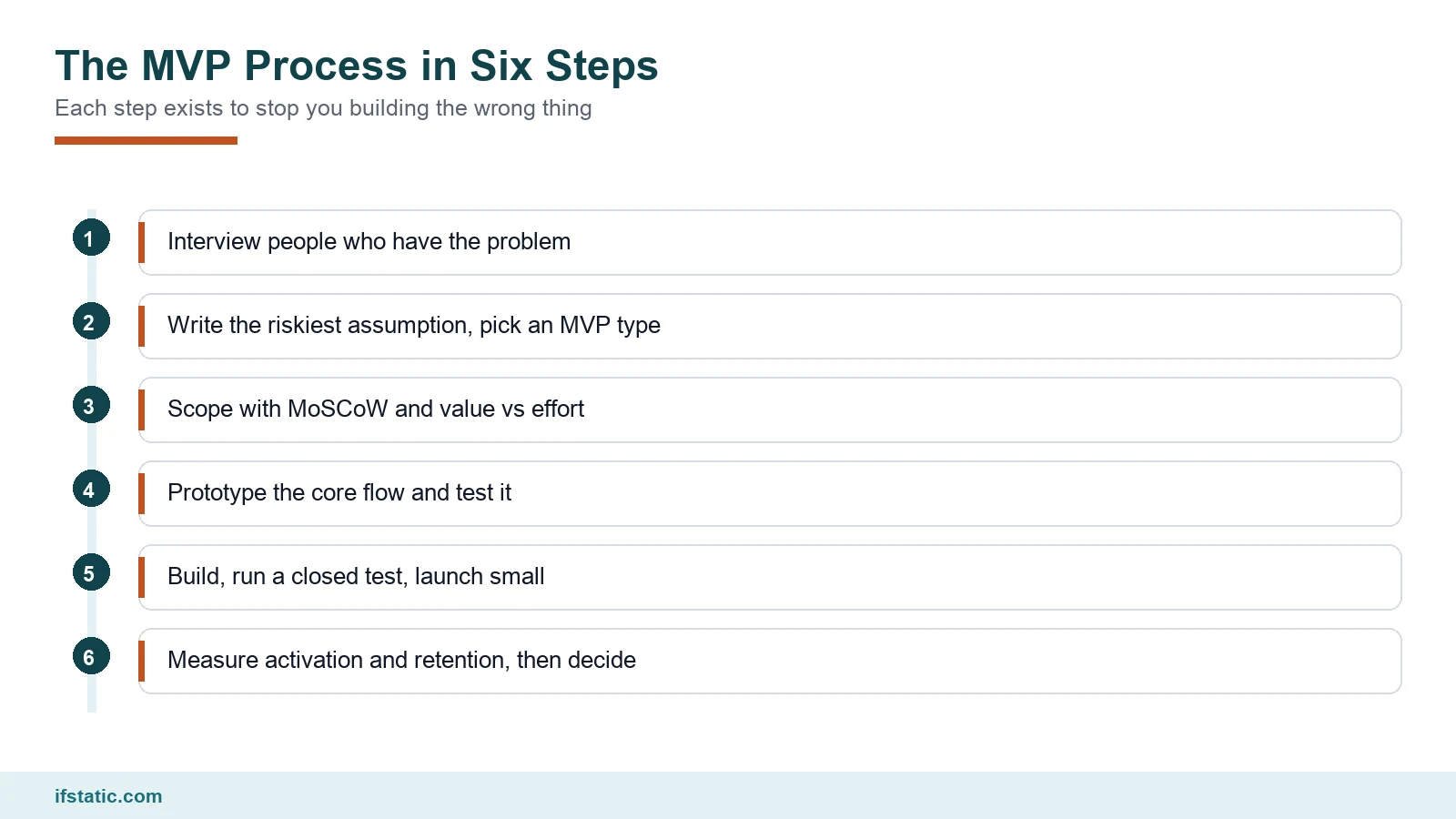
- Interview people who experience the problem, asking about the last time it happened, what they did and what it cost them.
- Write your riskiest assumption in a single sentence, then choose the MVP type that tests it with the least effort.
- Prioritise features using MoSCoW together with a value versus effort comparison.
- Design the core flow and test a clickable prototype with a small number of target users.
- Develop that flow, run a closed test, and then release it to a limited group of early adopters.
- Measure activation and retention, then decide whether to continue, change direction or stop entirely.
Problem Interviews Come Before Screens
Speak with potential customers before you design a single screen, and ask about past behaviour rather than future intentions. People are polite in interviews, so they will usually say they would use your application. What they actually did last week is a far more reliable signal.
- When did you last experience this problem, and what exactly did you do about it?
- What did the problem cost you in money, time or professional reputation?
- Which tools, services or informal workarounds are you using today?
- Have you ever paid for a solution, and if so, who received that payment?
If nobody has attempted to solve the problem, it may not be painful enough to support a business. That is still a valuable finding, and it cost you nothing except a few cups of chai.
Prototype, Then Build One Flow Well
Once the interviews confirm a genuine need, convert the core flow into a clickable prototype, because this is the cheapest stage at which to correct a mistake. Moving a button in a design file takes minutes, while moving it in production code can consume an entire sprint. Our guide to the UI UX design process explains this stage in detail.
After that, develop only the chosen flow, and develop it to genuine production quality. Authentication, the core action, payments if necessary and a basic administration panel are usually sufficient, while everything else waits for evidence.
Organise development into short cycles of one or two weeks, and review working screens at the end of each cycle. Founders who see regular progress tend to notice wrong decisions early, before they become expensive rework.
How to Scope Features So the MVP Stays Small
Scope is where most MVP budgets collapse, because every stakeholder has a favourite feature and each one sounds small in isolation. Two simple techniques keep the list honest: MoSCoW prioritisation and a value versus effort matrix.
MoSCoW, Measured by Effort
MoSCoW classifies every feature as Must Have, Should Have, Could Have or Won't Have this time. The Agile Business Consortium, which maintains the DSDM framework, interprets MUST as the Minimum Usable SubseT of the requirements you deliver.
Its most valuable guidance concerns effort. DSDM recommends spending no more than 60% of planned effort on Must Haves, with around 20% reserved for Could Haves. Those Could Haves work as contingency, so when a Must Have takes longer than expected, you remove a Could Have instead of missing the launch date.
Notice that the rule measures effort, not the number of features. Five Must Haves requiring one day each are completely different from five requiring three weeks each.
The Value Versus Effort Matrix
Plot every feature according to how much it helps your first customers and how difficult it is to build. The four quadrants produce a sensible first cut before the MoSCoW discussion even begins.
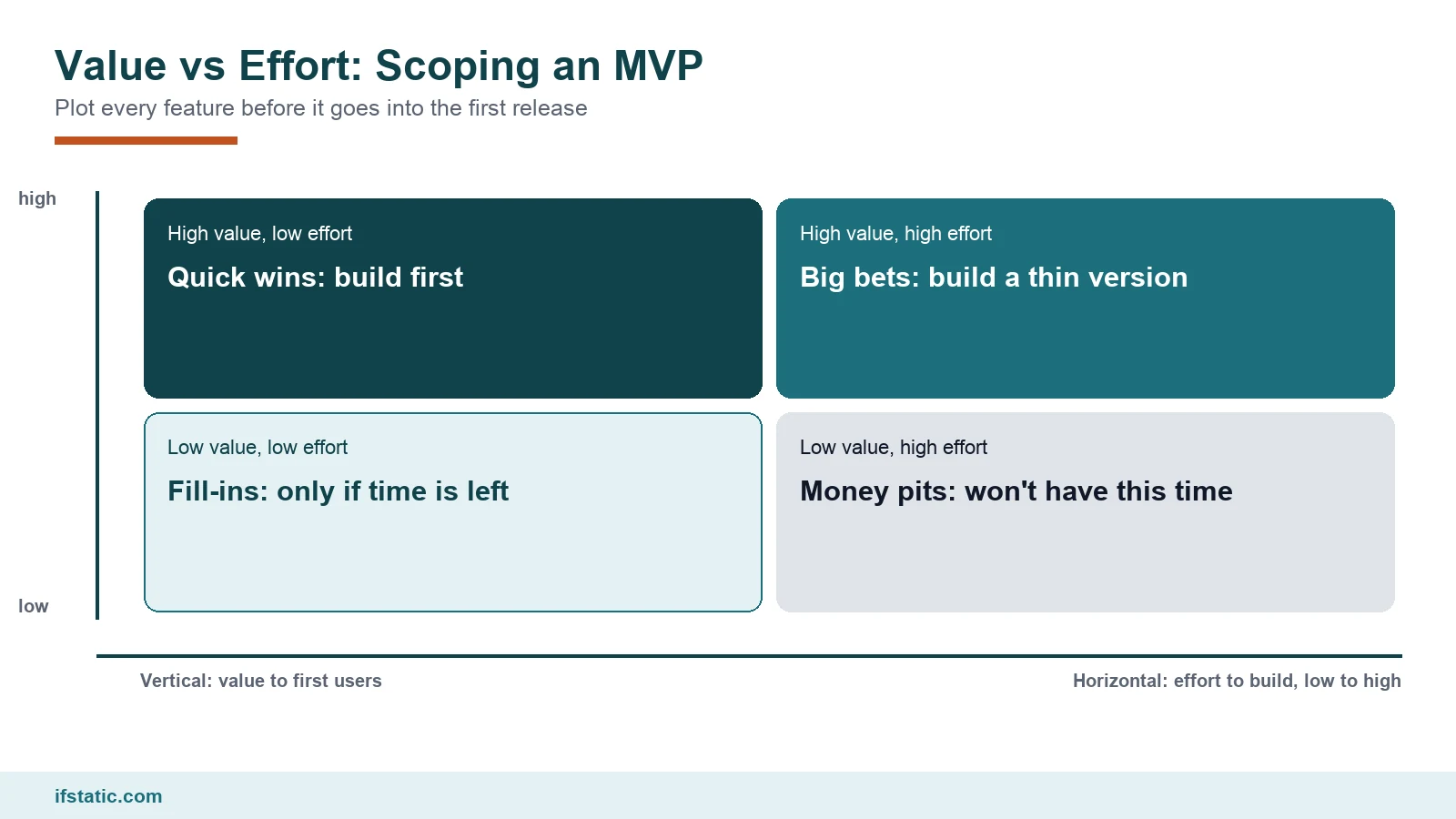
- High value and low effort: these quick wins belong in the first release, because they deliver visible benefit for very little development time.
- High value and high effort: treat these big bets carefully and build the thinnest version that still tests the underlying idea.
- Low value and low effort: these fill-ins are optional additions, so include them only if time remains after the essentials.
- Low value and high effort: these money pits should be marked Won't Have this time and revisited only if customers request them.
Worked Example: A Turf Booking App
Consider a sports field booking application, the same category as BookMyPlay in our portfolio. That finished app includes team creation, match challenges, split payments and events, which makes it a complete product rather than an MVP. If you were testing the same idea from zero, the feature list would shrink quickly.
The effort figures below are approximate planning estimates for one experienced cross-platform developer, expressed in working days. They are not a quotation, and they exist only to demonstrate how the 60% rule operates in practice.
| Feature | Value to first users | Effort estimate (days) | MoSCoW call |
|---|---|---|---|
| Phone OTP login | High | 3 | Must |
| Nearby fields with photos and price | High | 6 | Must |
| Slot calendar and booking | High | 10 | Must |
| Online payment | High | 5 | Must |
| Owner panel to block slots | High | 6 | Must |
| Booking reminders | Medium | 4 | Should |
| Ratings and reviews | Medium | 6 | Should |
| Split payment among players | Medium | 6 | Could |
| Referral codes | Low | 4 | Could |
| Teams, challenges and events | Low at launch | 20 | Won't have this time |
The Must Haves total 30 of the 50 planned days, which is exactly 60% of the effort. Team features are appealing, but a first customer only needs to find a field and book it. If bookings repeat, teams become an easy second release, and if they do not, you have saved 20 days of development.
Tech Stack and Realistic Timelines for Indian Founders
For most app MVPs, a single cross-platform codebase combined with a managed backend is the sensible default. You release on Android and iOS together, and you avoid building server infrastructure from scratch.
Cross-Platform Frameworks and a Managed Backend
Flutter describes itself as a way to build multiplatform apps from a single codebase. React Native renders to native platform interface components, and its official website recommends starting new projects with a framework such as Expo. Both are reliable foundations for an MVP, so choose the one your developers already know well.
- Flutter, with a single Dart codebase, suits highly customised interfaces, although it is the wrong fit for a JavaScript-only team facing a tight deadline.
- React Native with Expo is a natural choice when your web developers already write React, although it is the wrong fit for a team with no React experience.
- Native Kotlin and Swift offer the best device access and performance, although they are the wrong fit for most MVPs, because every feature is built and tested twice.
- A no-code builder is the fastest route to a clickable experiment, although it is the wrong fit for apps needing custom logic, offline operation or heavy data processing.
For the backend, Firebase is a popular option. Its pricing page lists a no-cost Spark plan that includes 50K monthly active users for authentication, 1 GiB of Cloud Firestore storage and 50K document reads per day. Analytics, Crashlytics and Cloud Messaging are listed as no-cost on every plan.
One limitation matters particularly in India. Phone number authentication is not included in the Spark plan, and on the pay-as-you-go Blaze plan it is billed per SMS sent. If your application relies on OTP login, budget for the Blaze plan from the first day.
Payment integration is also simpler than it once was. Razorpay provides an official Flutter plugin that wraps its native Android and iOS SDKs, so checkout functionality does not need to be engineered from scratch.
Timeline Bands and Their Assumptions
Timelines depend on scope, team size and how quickly you provide feedback. The bands below are planning estimates rather than promises, and each row states the assumption behind it. The final row comes from store requirements, not from development effort.
| MVP type | Typical band (estimate) | Assumes |
|---|---|---|
| Concierge | 1-2 weeks | A landing page, WhatsApp and a founder doing the work by hand |
| Clickable prototype | 1-3 weeks | One designer and one core flow of a handful of screens |
| Wizard of Oz | 3-6 weeks | A real front end, a manual back office and no store release |
| Single-feature app | 8-14 weeks | One designer, two cross-platform developers, a part-time tester, frozen scope |
| Google Play buffer | About 3 weeks | New personal account: 14-day closed test, then a review that usually takes 7 days or less |
That final row surprises many first-time founders. Google Play states that new personal developer accounts created after 13 November 2023 must run a closed test with at least 12 testers opted in for 14 consecutive days. Only after that can you apply for production access.
According to the same page, the review usually takes seven days or less, so include it in your schedule. Recruit your 12 testers from the people you interviewed earlier, since they already care about the problem. The closed test then becomes your first round of genuine feedback.
For budgeting, the calculation is estimated hours multiplied by the team's hourly rate. Our guide to app development cost in India explains the factors that push that number up or down.
Store Accounts and Startup India Checks
Google Play charges a US$25 one-time registration fee, while Apple's Developer Program costs US$99 a year, displayed in local currency where available. Budget for both if you are launching on Android and iOS together.
If you enrol with Apple as a company, you need a D-U-N-S Number so that Apple can verify the legal entity, so apply for it early. TestFlight lets you distribute beta builds, but external testers only receive a build after it passes App Review for TestFlight.
If you have incorporated, review the rules for DPIIT startup recognition, which is free. The entity must be a private limited company, partnership firm, LLP or cooperative society. It must also be under 10 years old, with turnover below ₹200 crore in every previous financial year.
DeepTech startups receive wider limits of 20 years and ₹300 crore. Recognised private limited companies and LLPs incorporated after 1 April 2016 can then apply for the Section 80-IAC tax holiday, covering 3 consecutive financial years out of their first ten.
Recognition is not required to build or launch an application. It simply opens opportunities you may want later, so it is worth checking once your company exists.
What to Measure After Launch and Mistakes to Avoid
Launch is the beginning of the experiment, not the end of it. Before release, write down which result would prove your assumption correct and which result would prove it wrong. If you define the target after seeing the numbers, you will always find a convenient reason to continue.
Activation and Retention
Activation is the percentage of new users who complete the core action within a defined period, such as a first booking within seven days of registration. It indicates whether the application delivers its promise quickly enough.
Retention is the percentage of users who return after day 1, day 7 and day 30, and it indicates whether that promise continues to hold. For an MVP, retention matters more than downloads, because advertising can buy installations but cannot buy repeated usage.
| Metric | What it answers | Example for a booking app | Where to track it |
|---|---|---|---|
| Activation rate | Do new users reach the core value? | Users who book a slot within 7 days of sign-up | Analytics events |
| Day 7 and day 30 retention | Do they come back? | Users who book or browse again after 7 and 30 days | Analytics cohorts |
| Repeat payment | Is the value worth paying for twice? | Paying users who pay again within 30 days | Payment records |
| Crash reports | Is quality spoiling the test? | Crashes in the booking and payment screens | Crashlytics |
| User calls | Why do people stay or leave? | Short calls with active and lapsed users | Your notes |
Since Firebase lists Analytics and Crashlytics as no-cost, there is no reason to launch without measurement. Record the core action as an analytics event from the very first build, not as an afterthought.
Common MVP Mistakes
- Building for everyone at once, when you should begin with one city, one customer type and one specific use case.
- Treating the MVP as your permanent architecture, instead of keeping the code clean without engineering for a million users you do not have.
- Skipping the closed test, even though real testers find the broken flows your own team has stopped noticing.
- Counting downloads instead of activation and retention, which are the numbers that show whether the idea actually works.
- Adding features when the numbers look weak, although a weak signal usually means the core flow or the audience is wrong.
- Choosing a development partner on price alone, since an unstable build wastes the one thing an MVP must produce, which is reliable learning.
AI coding tools can accelerate parts of development, but judgement about scope and quality still determines the outcome. We discussed that trade-off in why app development still needs experienced developers.
Conclusion
Effective MVP app development is disciplined learning rather than rushed building. Identify your riskiest assumption, choose the cheapest MVP type that tests it, keep Must Haves within 60% of effort, and plan for store requirements before announcing a launch date. After release, let activation and retention guide your next decision. For help scoping and building your first release, talk to IfStatic about a quotation.
Whatever you build, keep the first version deliberately narrow. Adding a feature that customers request is far easier than removing one that nobody used. You can also browse our app development portfolio to see the kinds of applications we build.
Frequently Asked Questions
What is MVP app development?
MVP app development is the practice of building the smallest version of an app that can test one risky business assumption with real users. Eric Ries defined the MVP by learning rather than size, as the version that produces the most validated learning about customers for the least effort. Prototypes and trimmed full products are different, because neither is designed to answer one clear question.
How long does MVP app development take in India?
It depends on the MVP type. As rough planning estimates, a concierge experiment can run in one to two weeks. A single-feature coded app often takes eight to fourteen weeks with a small team and frozen scope. Add about three weeks if you publish from a new personal Google Play account, because of the 14-day closed test and the subsequent review.
How much does an MVP app cost?
Cost is estimated hours multiplied by the team's hourly rate, so scope influences the price more than anything else. A concierge experiment or clickable prototype costs little beyond your own time. For a coded MVP, prepare a feature list with MoSCoW decisions first, then ask several development teams to quote against that identical list so the quotations are comparable.
Should my MVP be Android only or cross-platform?
If your customers use both platforms, a cross-platform framework such as Flutter or React Native lets you release both from one codebase. Launching on Android first can make sense when your early adopters mostly use Android devices and you prefer to manage one store process. Separate native Kotlin and Swift applications are rarely worth the duplicated effort at MVP stage.
Is Firebase free for an MVP app?
Much of it is. The Spark plan is no-cost within limits such as 50K monthly active users for authentication and 50K Firestore document reads per day. Analytics and Crashlytics are listed as no-cost on every plan. Phone number authentication is the important exception, because it is unavailable on Spark and billed per SMS sent on the Blaze plan.
Do I need DPIIT recognition before building an MVP?
No. DPIIT recognition is optional and free, and you do not need it to build or publish an application. It applies to a private limited company, partnership firm, LLP or cooperative society under 10 years old with turnover below ₹200 crore. It is worth checking once you incorporate, because it enables later benefits such as applying for the Section 80-IAC tax holiday.
Sources, Method and Author
How this guide was researched: we read the Google India top 10 for MVP app development on 25 September 2026 and six competitor guides in full. We then opened Eric Ries's 2009 post, the DSDM MoSCoW page, Google Play, Apple and Firebase pages and the Startup India recognition page. Timeline bands and effort days are planning estimates, not measured data, and we found no primary benchmark for activation or retention, so none is given.
About the author: Aman Raj is a Director and Website Designer at IfStatic Technologies in Greater Noida West. He works on the design, build and launch of websites and apps for IfStatic clients and writes the company's guides on planning digital projects.